Arctic Viking is lost
The trawler capsizes off Flamborough Head and later sinks, with five men lost and fourteen rescued by Derkacz.
Wreck site · 28 June 2009 · North Sea
Nearly forty-eight years after Arctic Viking went down, divers reached the wreck in deep water off Flamborough Head. The ship was no longer only a report, a memory, or a court finding. She was there on the seabed, lying on her side in silt and shells.
The 2009 dive
The wreck report records that Andy Dowsland dived Arctic Viking on Sunday 28 June 2009 with Brian Smith and Carl Racey. The site lay about twenty miles out from Flamborough Head, in roughly seventy metres of water.
Conditions were unusually favourable for such a serious dive: more than fifteen metres visibility and ambient light reaching the seabed. Even so, the report makes clear the scale of the undertaking. Dowsland and Smith dived closed-circuit rebreathers using 17/40 trimix; Carl Racey joined for a shorter time on open circuit.
The divers had around twenty-five minutes exploring the wreck before the long ascent and decompression. Total dive time was recorded as just over two hours. The report's tone is practical, but the emotional weight breaks through: the first sight of Arctic Viking came as the keel appeared from the north.
For the Arctic Viking story, the dive created a new kind of evidence. It did not replace survivor testimony or the Ministry inquiry. It gave the ship herself a physical presence again.
What they saw
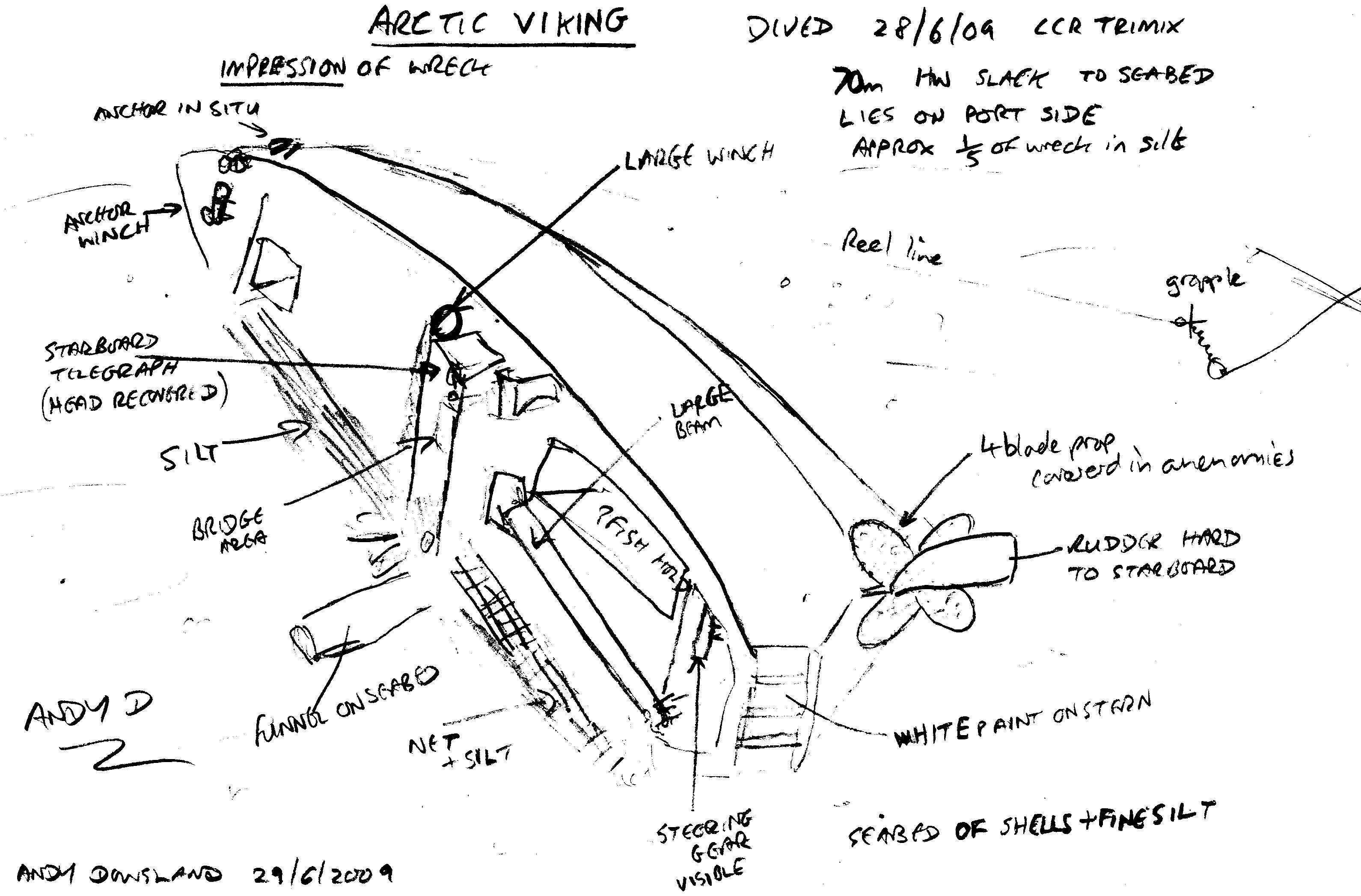
The wreck was described as an intact trawler lying completely on her port side on a seabed of fine silt, mud and shells. There was no significant scour noted. The wreck was partly silted, and stood about four to five metres high from the seabed.
The orientation was recorded clearly: keel to the north, decks to the south. The divers swam over the bow, past an anchor still stowed, then along the deck towards the bridge area. A large winch was visible in front of the wheelhouse.
The top part of the wheelhouse had decayed away. Just aft of the bridge, the funnel lay on the seabed. Farther aft, a long beam with ropes or cables attached was noted. White paint could still be seen on the stern.
At the stern, the wreck had a four-blade propeller, colourfully covered in plumose anemones. The rudder pointed upwards and was hard to starboard. The report is careful about interpretation: that rudder position might reflect an attempted turn, but it might also have happened as the ship sank or later through seabed movement or fishing gear contact.
Diver sketch
Andy Dowsland's wreck impression is one of the most useful visual records in the vault. It marks the anchor still in place, anchor winch, bridge area, recovered starboard telegraph, silt, funnel, large beam, propeller, rudder and white paint on the stern.
The drawing is not a formal archaeological survey. It is a diver's working record from a deep technical dive, made close to the event and matched by the written report. For a website reader, it makes the wreck legible: bow, bridge, funnel, stern and propeller all become places again.
Image: wreck impression from the Arctic Viking wreck report in the research vault.
Recovered artifact
The most important recovered artifact was the starboard wheelhouse telegraph head, identified as a Chadburn's telegraph. The wreck report notes that it was recovered from the starboard side of the wheelhouse, where the upper wheelhouse structure was decayed and broken open.
After partial cleaning, the telegraph indicated full steam ahead. The research treats this carefully. It supports the idea that the vessel was still under power when she went down, consistent with the urgency and action described by survivors and inquiry evidence.
It should not be overread as a complete explanation of the final seconds. A telegraph is a powerful artifact, but it is still one piece of evidence. The rudder position is similarly suggestive but uncertain. The wreck can confirm details; it cannot answer every question.
Even with that caution, the telegraph has deep emotional force. It is a physical object from the wheelhouse where David Cressey, Philip Garner, Ronald Dodsley and William Marshall fought the ship's last moments.
Recovered pieces
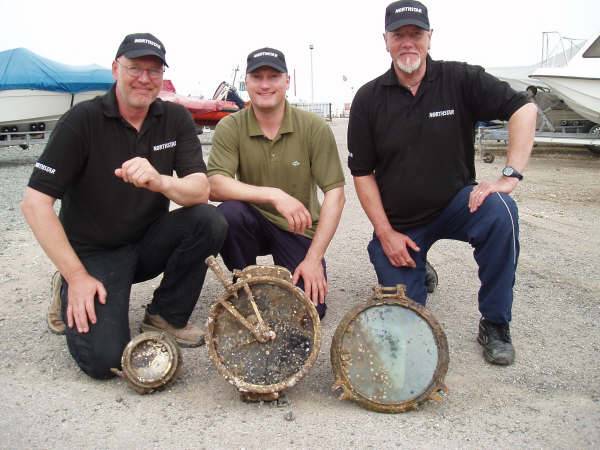
The recovered telegraph later became central to a public memory story. Hull Daily Mail reporting described how Tony Craft, grandson of lost crewman David Craft, tracked down Andy Dowsland after reading about the Arctic Viking online.
Tony Craft said the disaster had deeply affected his family. After meeting Dowsland, he wanted the telegraph to be available to the wider Hull fishing community. Dowsland agreed to loan it to the Hull Trawler Museum, run by the fishing heritage group STAND.
This matters because the artifact did not remain only a diver's find. It became part of the way families, researchers and Hull's fishing heritage community could encounter the Arctic Viking again.
Position and uncertainty
The vault records two positions that should not be casually merged. The Ministry of Transport inquiry gave the loss position as approximately 54°15'N, 0°10'E. The 2009 dive note gives the wreck position as 54°18.51'N, 00°21.551'E.
That difference is not surprising. A casualty position may be approximate, reported under emergency conditions, or tied to where the ship capsized rather than the final resting place. The wreck position comes from the later dive record.
For this site, the safest wording is that Arctic Viking was lost off Flamborough Head and that the wreck dived in 2009 lies about twenty miles offshore in roughly seventy metres of water. Exact coordinates should be checked against the original wreck record before being used for navigation or publication outside this research context.
Museum connection
The later newspaper story centres on Tony Craft, grandson of David Craft, one of the five men lost on Arctic Viking. For Tony, the telegraph was not just machinery. It was a piece of family history and a link to a grandfather whose death shaped the lives of those left behind.
The article records that the artifact was to be loaned to the Hull Trawler Museum. That decision widened the meaning of the find: from a private family connection into a public memorial object.
In this way, the 2009 dive did something unusual. It connected the seabed, the survivor record, family memory and Hull's fishing heritage. The telegraph came up from the wreck, but the story it carried belonged to more than one family.
Why the wreck matters
The wreck is evidence. It shows Arctic Viking as an intact trawler, lying on her port side, with features that can be compared to the inquiry record: wheelhouse, telegraph, funnel, propeller, rudder, silt, and the orientation of the vessel.
The wreck is also a grave site in the moral sense. Five men were lost with the ship or in the sea around her: David Craft, Edward Kent, Dennis Lound, John Robinson and Samuel Waddy. The page therefore avoids treating the dive as treasure hunting or spectacle.
David Cressey's later family recording shows how unresolved this remained for survivors too. He wondered what divers might or might not have seen and whether the bodies had drifted away or remained trapped. Those are painful questions, and the site should handle them as family memory rather than as settled forensic fact.
The wreck's importance is that it gives the story weight. Arctic Viking was not only lost in a line of text. She remained on the seabed for decades, silent, damaged, and recognisable.
Wreck chronology
The trawler capsizes off Flamborough Head and later sinks, with five men lost and fourteen rescued by Derkacz.
Andy Dowsland, Brian Smith and Carl Racey dive the wreck in roughly 70 metres of water and record her lying on her port side.
Wrecksite-style notes record recovery of the Chadburn telegraph and electric log indicator, visibility, orientation, silt, propeller and rudder position.
Andy Dowsland's fuller written report describes the dive, the wreck features and the significance of the telegraph.
Reporting describes Tony Craft meeting Andy Dowsland and the telegraph being loaned to the Hull Trawler Museum.
Sources used include the Arctic Viking wreck report, the location note, Hull Daily Mail reporting on Tony Craft and Andy Dowsland, David Cressey's family transcription, and the Arctic Viking Obsidian research vault. The dive position and inquiry position are both recorded, but should not be treated as identical.
Wreck report credit
This page uses details from the Arctic Viking wreck report with kind permission from Andy Dowsland. The original wreck report is published on Wrecksite.eu.
The report, drawing and recovered-artifact context are credited here because they are central to understanding how the wreck was identified, dived and recorded in 2009.